




The Connecticut Developmental Disabilities Network (DDN) was established to provide leadership for implementation of the federal Developmental Disabilities Assistance
and Bill of Rights Act.
Read More>>
People with disabilities and their families are
at the heart of how we plan, complete,
and evaluate our activities.
We also rely on a broad range of professionals, organizations and agencies
to bring about community-wide change.
Read More>>
Welcome to the University of Connecticut
Center for Excellence in Disabilities Website!
Established in 1985, the Center is committed to improving the lives of individuals with disabilities and their families. The Center employs interdisciplinary staff representing a variety of experiential, training, and multicultural perspectives. Three-quarters of the centers employees either has a disability or has a family member with a disability.
The Center provides model programs in innovative disability related research, training and technical assistance. Strong collaborations with the University of Connecticut, University of Connecticut Health Center and Disability Network contribute to the Center’s success in advancing policies and practices to support individuals with disabilities.
All activities of the Center are guided by a belief in individualized supports, inclusion, self-determination, natural supports and collaboration with organizations to address policy issues and systems change.
The goal of the Center is to develop, implement, and disseminate a coordinated group of applied research, demonstration and training projects directed at meeting the needs of persons with disabilities and their families in community based settings.
What's New
- IN THE NEWS
UConn UCEDD Director, Mary Beth Bruder, Ph.D., calls for use of stimulus funds to train professionals in Birth-to-Three programs.
In a recent Education Week article about federal economic-stimulus money for education, Dr. Bruder was quoted as saying, “Personnel needs are tremendous, as are service-coordinator needs. We’re not training enough, and we’re not training well, in the preservice arena. "
- SAVE THE DATE
September 15, 2009
Working Together with a Medical Emergency:
Children and Youth with Special Health Care Needs
A One Day Workshop for Parents of Children with Special Health Care Needs, Emergency Medical Service Providers, First Responders, School Nurses, DCF Complex Medical Care Nurses, DDS Nurses and Caseworkers, Family Organizations, and Home Healthcare Nurses
- New UConn study in progress,
"Preventing Shaken Baby Syndrome: A Comparison of Two Parent Education Programs" is now available on the UConn UCEDD web site.
- UConn UCEDD provides editorial support to Infants and Young Children, an Interdisciplinary Journal of Special Care. Mary Beth Bruder, Ph.D, Professor of Pediatrics and Educational Psychology and the Director of the University of Connecticut A.J. Pappanikou Center for Excellence in Developmental Disabilities Education, Research, and Service, is now the editor of the Journal.
- UConn UCEDD receives LEND grant.
The Center is the recipient of one of four new LEND grants awarded by the Bureau of Maternal and Child Health, in the Department of Health and Human Services. The Leadership Education in Neurodevelopmental and Related Disabilities (LEND) is a training program for professionals aimed at improving the health of infants, children and adolescents who have, or are at risk for developing, neurodevelopmental and other related disabilities, with a special emphasis on autism spectrum disorders in Connecticut. The program seeks to achieve its mission by 1) training graduate and post-degree students seeking individualized multidisciplinary training experiences; 2) collaborating with state and local agencies to provide leadership education and training; 3) providing community and family leadership training opportunities; and 4) ensuring families and youth are included in LEND training activities. Click here for the abstract.
- Immediate Openings for Families As Faculty
The Center has immediate openings for families who would like to learn how to teach adults (graduate students and practitioners) in leadership skills in order to serve as co-faculty in the LEND project. Interested families should contact Molly Cole, Associate Director, at 860-679-1595 or mcole@uchc.edu.
- Leadership Training Opportunity
The University of Connecticut Center for Excellence in Developmental Disabilities, the CT Down Syndrome Congress and the CT Council on Developmental Disabilities are partnering to implement a six part leadership training series. This will consist of 40 hours of training, and will include one overnight session. Course content will include: History, Values, Legislative Process, IDEA, Health Care Access, Resources, Transition, Community Inclusion, Strategies to Run a Meeting, and Grassroots Organizing. We anticipate that this training will begin in early 2009. Interested parents should contact Molly Cole, Associate Director at 860-679-1595 or mcole@uchc.edu.
Early Childhood initiatives at the UCEDD
focus on evidenced based practices and learning outcomes. We provide training and technical assistance to early interventionists, teachers, therapists, service coordinators, policy makers and families on a variety of areas including social competence, early literacy, early childhood outcomes, service coordination practices, and evidenced
based intervention practices.
School Age initiatives at the UCEDD focus
on the inclusion of children with disabilities
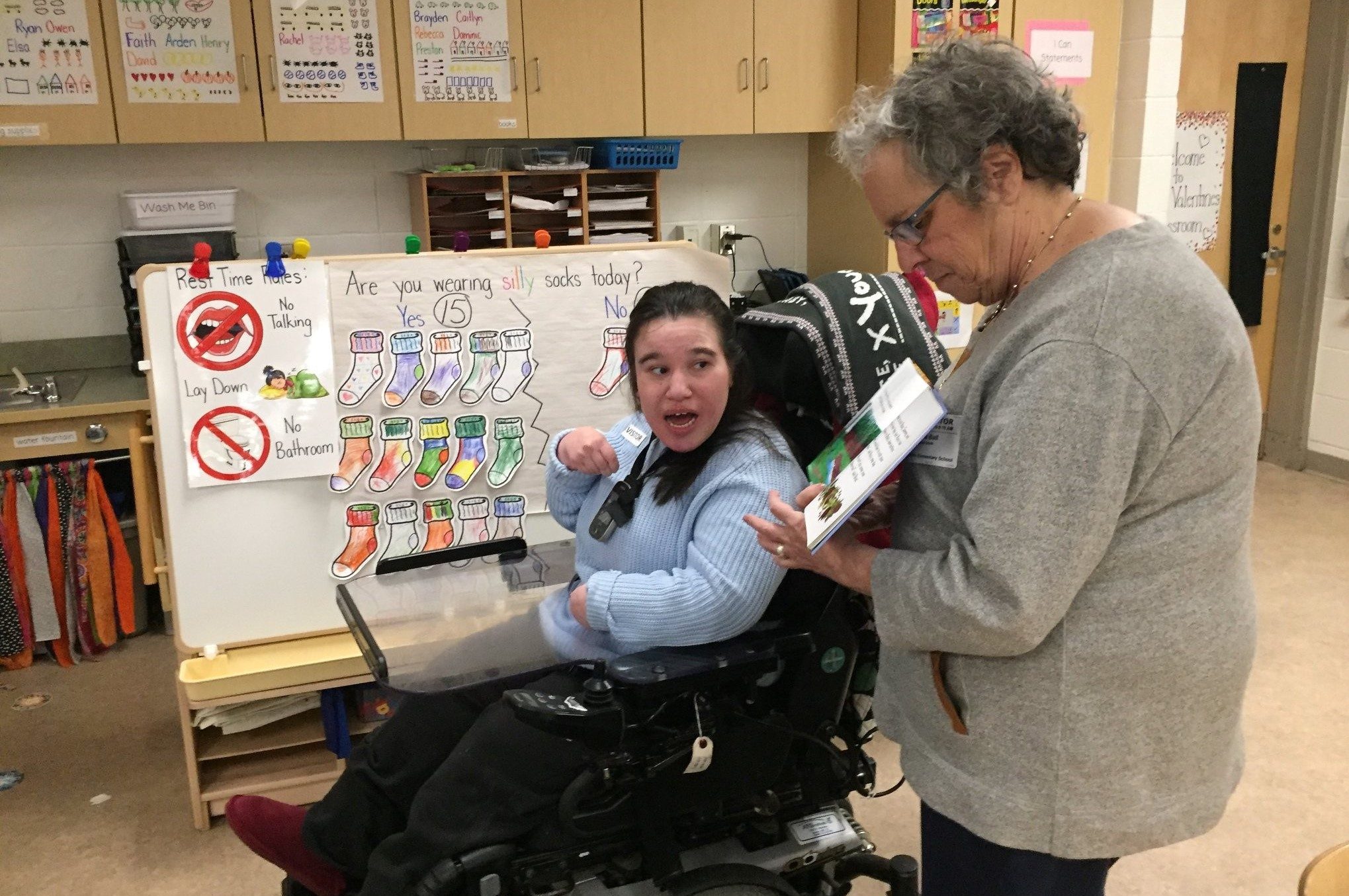
in typical school and community life. We provide training and technical assistance to families, school personnel and community members in a variety of areas including the special education process, inclusive education, adapted curriculum, assistive technology, disability awareness and
person-centered planning.
Adult initiatives at the UCEDD focus on including people with disabilities in their communities. We provide training and technical assistance to individuals with disabilities, state agencies, service providers and other community members in a variety
of areas including the hiring of personal assistants, accessible transportation, emergency preparedness and response,
and health care.